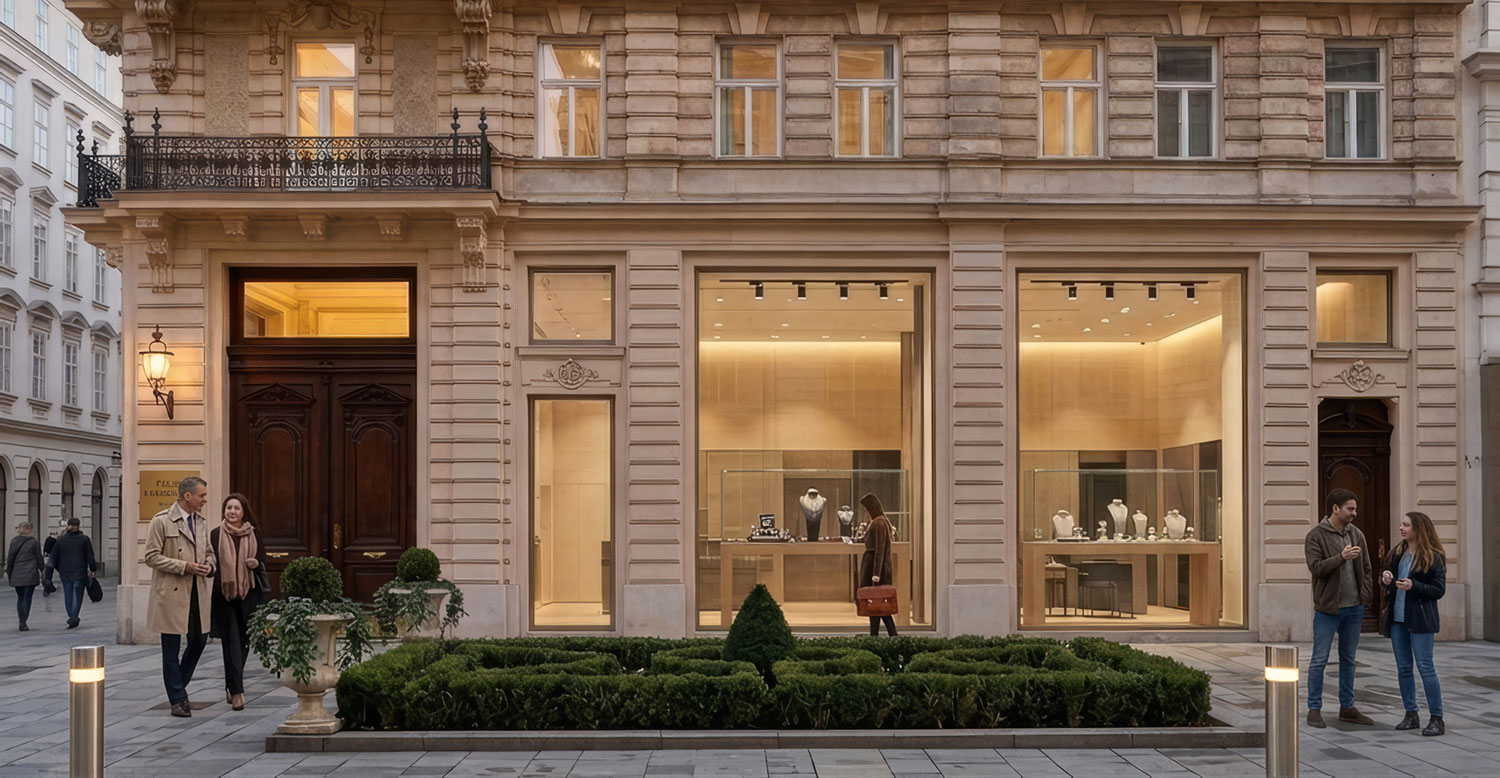
An American soldier, a stolen sale, and two words at a Swarovski counter in Stuttgart. How a stranger's parting advice at 19 rewired the way I show up — and still echoes in every room I walk into today.
When I started studying at my very first stop in Stuttgart, I told everyone, "No, I will start slowly and not search for a student job until the first semester ends, so I can really arrive." This mindset lasted for a maximum of four weeks; I soon noticed how boring it was to have so much free time. So I searched the job market and quickly got my first small job at the Swarovski store on Königstraße in Stuttgart. I didn't stay long because I wanted to get into the jobs I was actually studying for, but this time really taught me some things. I still look back at it as a precious period of learning and development. There's one moment in particular from my time at the Swarovski store that will stay with me forever — a moment where just two words completely changed my self-esteem.
It was two weeks before Christmas, and I had an afternoon shift that I shared with three full-time colleagues and another student worker like me. People were literally going crazy buying Christmas presents for their loved ones. I spent almost all of my shifts helping men and boys choose necklaces and bracelets for their girlfriends and wives. This shift was exactly like that.
As a jewellery nerd myself, I really liked recommending unique pieces to different people — not just the same minimalistic necklace for everyone. I had a different taste than most of my colleagues; I liked big, bold, attention-seeking designs. Sometimes I felt like my team didn't trust me with every customer because of this. They would never have chosen a big, colourful bracelet, but when a man told me just three sentences about his wife, I got a distinct feeling of exactly what she would love. Still, my team members would often interrupt my conversations to take over and show customers a different piece. Perhaps it was because the full-time team was assessed by the number of people they served. We students didn't have those metrics to meet, so I didn't care much. But that hyper-competitive mindset seemed to sift through to the other student workers as well. At least, that's how I tried to understand this one situation.
Everyone else on the team was occupied with customers. I was standing to the side, waiting for my turn again, when a man walked into the store, clearly searching for something. I walked over and asked if I could help him. He was incredibly kind and told me he was looking for a beautiful piece for his wife for Christmas. As I showed him a variety of options, he shared more about his wife and their life together. He was an American soldier stationed close to Stuttgart who had met his German wife within his first few months here. He chose to stay, and he absolutely loved living here with her. It was a wholesome conversation, and I noticed he was much more drawn to the less-minimalistic pieces. I was thrilled to show him my favourite Swarovski worlds.
Suddenly, the other student worker interrupted us and "stole" the conversation. She convinced him to buy a more minimalistic piece, arguing it was the safer choice because the pieces I was showing didn't fit every outfit, and he ran the risk of his wife not liking it. Just like that, I was pushed out of the deal. Even though he tried to keep me integrated and kept asking for my opinion, she took over. In the end, she sold him a different piece. He still seemed quite happy, but I was deeply disappointed and wondered why she would do that. As he was paying, I stood back near the front entrance, waiting again.
When he finished, he walked toward the exit, but he didn't leave right away. Instead, he turned to me, smiled, and tapped my shoulder.
"Hey, my love," he said. "Be fierce."
I was confused, but a smile emerged on my lips anyway.
"Our conversation was really wonderful and your recommendations were amazing," he continued. "Next time, do not let anyone take your spotlight, okay?" He gave me a big smile. "Always remember: Be fierce."
I smiled and thanked him for words that already meant the world to me. Then he left the store.
I stood there in awe, unable to move an inch, because I couldn't quite comprehend what had just happened. I was literally just 19 years old, and I had never had a stranger offer me such profoundly encouraging words. Inside me, I slowly began to feel what this interaction had unlocked. At that exact moment, I couldn't have guessed how deep and how long this effect would last. Today, the words "Be fierce" still carry a powerful echo in my head.
I remember how disappointed I initially was by my colleague. Eventually, we had a very honest conversation where I told her I didn't appreciate what she did — and we actually became work besties after that. Reflecting on the whole situation today, I'm profoundly thankful for how it played out. Missing out on that single sale had a monumentally bigger impact on my self-esteem than keeping it ever would have.
Those two words became an anchor. At 19, you don't yet realise that the professional world will constantly test your boundaries. People will try to talk over you, soften your edges, or steer you toward the "safe, minimalistic" choice because your natural instinct is bold and unapologetic. That brief encounter on a chaotic December afternoon fundamentally rewired how I show up in my life today.
Before that soldier walked into the store, I was content to fade into the background when challenged, assuming seniority or aggressive ambition justified someone else stealing my spotlight. Today, I know better. "Be fierce" isn't about being loud for the sake of it; it's about absolute trust in your own vision and your own taste. When I develop concepts, pitch ideas, or take on new challenges now, I don't aim for the safe choice just to avoid friction. I lean into the distinct intuition that sets me apart.
Looking back, that retail floor was my first real boardroom. It taught me that conflict doesn't have to be destructive — but more importantly, it taught me that you cannot let people dilute your value or hijack your momentum.
To this day, whenever I feel a slight hesitation before a major moment, or when the urge to compromise my standards creeps in to keep the peace, I still hear that loud echo in my head. I take up space. I own the room. I don't give away my hard work, and I certainly don't surrender my spotlight.
Because of a stranger's fleeting kindness in a crowded Swarovski store, I don't just survive in competitive spaces. I rule them.