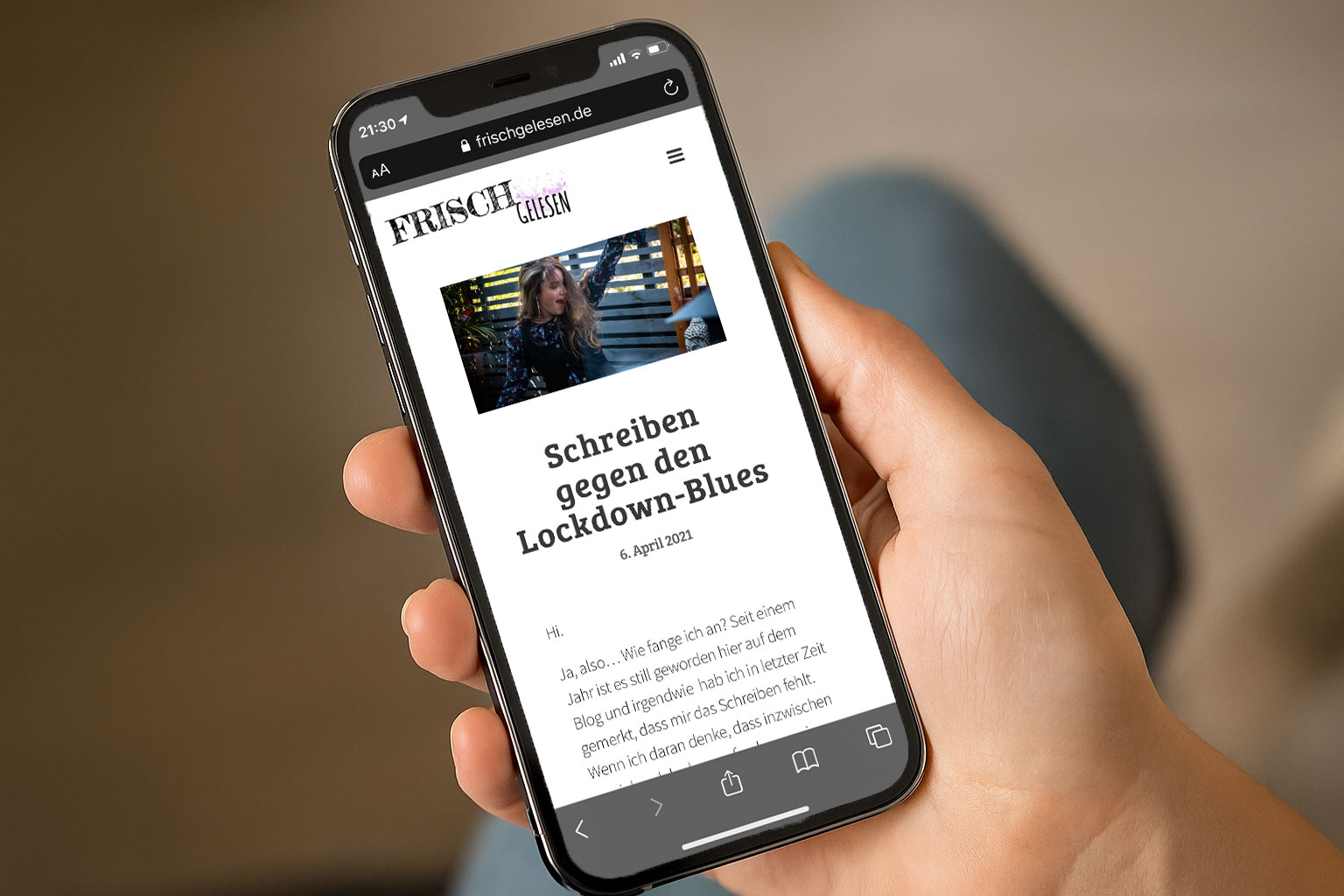
A 14-year independent editorial project — frischgelesen.de — that started in primary school as a book blog and grew into a lifestyle publication with a consistent voice, original photography and a real reader community. Currently dormant, revival in planning. The foundation under everything I now do professionally in editorial voice, brand consistency and visual storytelling.
The Challenge
I started frischgelesen.de in primary school, at six to nine years old, as a book blog with a child's seriousness about reading. Over the next fourteen years it grew into a lifestyle editorial site with original writing, original photography and a small but real readership — sustained continuously through every school change, every move, every identity shift, and an exchange year abroad, until I chose to put it down around 2019.
The challenge was, in hindsight, the hardest brief any creative ever gets: keep a single editorial project alive across fourteen years, with no external structure, no deadlines, no manager, no syllabus — while the person writing it changes more drastically than any other audience-facing project will ever require.
My Approach
I held the editorial principles constant — genuine voice, honest opinion, real photographs, no sponsored-content compromise — while letting everything else evolve in step with the person writing. Voice, design, topic mix and visual treatments shifted across the years; the brand stayed legible. Photography began as a collaboration with my parents (my eye, their hands on the camera) and progressively became my own work, codified by A-Level Photography during my exchange year abroad — the moment instinct met training.
The discipline behind it was unglamorous: post, listen to readers, read my own writing back, notice what didn't sound like me, stop doing those things. Repeat for a decade. Community was built the only way community can be — recognisable point of view, sustained reliability, willingness to actually respond. None of it scaled. All of it compounded.
Results & Outcome
A 14-year continuous editorial practice — the longest-running thing I have ever made, and the foundation under everything I now do professionally. Brand voice work for clients, editorial direction, photography direction, community thinking, long-arc project ownership and brand consistency through change — every one of these is a faster version of the work I did slowly across fourteen years on this site.
The project went dormant by choice, not by drift. Knowing when to end a project is its own competency — the same instinct that lets me scrap a campaign concept eight weeks in when it has stopped doing its strategic job. Revival is in planning: not as a restart, but as a continuation. Continuity is harder to earn than newness, and I would rather earn it than chase it.
Services Delivered
A project that began before I could properly spell Rezension, and ended only when I chose to put it down.
frischgelesen.de is the longest-running thing I have ever made. It started somewhere in my primary school years — I was six to nine years old, depending on which moment you count as the beginning — as a book blog. A child writing about the books she had read, with the seriousness only a child can bring to a thing like that. Over the next fourteen years it grew into something I now recognise as my first real editorial practice: a lifestyle blog with a consistent voice, an evolving visual language, a regular publishing rhythm, and a small but real readership that came back week after week.
The blog is currently dormant. The site is offline. The revival is planned but unscheduled. Until then, this is the case study — not for what it looks like now, but for what it actually was, and what fourteen uninterrupted years of writing, photographing, designing and publishing taught me before I had any of the professional vocabulary to describe what I was learning.
A misconception I want to clear up first, because it matters for how this case study reads: a long-running personal blog is not the same as "having a website as a kid". It is not a phase. It is not a diary. It is a sustained creative practice, and at fourteen years of duration, it is longer than most people's professional careers in any single discipline.
The project started as a book blog — frischgelesen means just read, in the sense of just finished reading. I wrote about books I had read, in the voice of a child who took books seriously. The reviews were short at first, then longer, then more opinionated. I learned, somewhere along the way and entirely by accident, that the difference between a forgettable review and one people came back for was the presence of a recognisable voice. By the time I was in my early teens, the voice was identifiable enough that returning readers would comment when it shifted.
The shift from book blog to lifestyle blog happened gradually rather than as a decision. Books stayed in the editorial mix, but they were joined by writing about everyday life, places I went, things I noticed, small observations that didn't have anywhere else to go. The transition is, in retrospect, exactly the kind of category expansion every editorial brand has to manage at some point — and I was learning to do it instinctively while my professional self was still a decade away.
The photography started as a collaboration with my parents. I had the eye and the ideas, they had the actual camera and the technical skills to get the shot. As I got older, I took over more of the production. The real turning point came during my exchange year abroad, where I took A-Level Photography as one of my subjects. That year codified for me — academically and practically — what I had been doing instinctively for a decade: composition, light, exposure, the relationship between an image and the story it sat next to. I came back able to shoot for the blog with intention rather than imitation.
This is the part of the case study that matters professionally. A long-running independent project teaches things that a degree, an internship, and even a first job cannot teach, because none of those have the duration. Here is what frischgelesen actually built in me.
I was writing in a recognisable voice years before I would have been able to define what a "voice" is. The mechanism is the only one that exists for developing a voice: write a lot, publish what you write, read your own writing back later, notice what doesn't sound like you, stop doing those things. Repeat for a decade.
The professional consequence is that by the time I was writing brand copy for clients — service pages for a Saxon carpentry, blog posts for my own portfolio, internal strategy documents at a luxury watch manufacturer — voice was not something I had to learn. It was something I had to adapt. I already knew what consistency felt like from the inside, because I had spent fourteen years building it for one brand: my own.
This is the single most underestimated competency in marketing and brand work. Voice is the asset that takes the longest to build and that no shortcut will produce.
I did not have a content strategy. I did not have a posting calendar. I did not run analytics. What I had was a small group of readers who came back, commented, suggested books, disagreed with reviews, told me when I had been unfair, and built — through years of casual interaction — exactly the kind of relationship every brand now tries to engineer with the word community.
What I learned was simple and is widely ignored: a community forms around a recognisable point of view, sustained reliability, and a willingness to actually respond. None of those things scale, and the absence of any one of them kills the community. Most brands fail at community because they want the outcome without the cost. I learned the cost early.
A school project has a deadline. A job has a manager. A degree has a syllabus. A personal blog you start at age seven and run until you are twenty-one has none of these. The structure is whatever structure you build for yourself.
What this teaches, slowly and irreversibly, is the discipline of self-directed long-form work. The ability to keep a project alive through years of school changes, moves, exchange years, exam periods, friendship dramas and identity shifts is not a soft skill. It is the underlying capability that makes everything else possible. Most professional creative careers fail not because the person lacks talent but because they cannot sustain a practice across years without someone telling them to.
By the time I was working professionally, the question can I keep this going for the long arc was not a question I had to ask. The answer was already evidence.
A blog you start in primary school and continue into adulthood is a unique kind of brand problem. The person writing it changes more drastically over those fourteen years than any other audience-facing project will ever require. The site has to remain itself while the author becomes a different person every two years.
I solved this without knowing I was solving it: I held the editorial principles (genuine voice, honest opinion, real photographs, no sponsored content compromise) constant while letting everything else — the design, the tone, the topic mix, the visual treatments — evolve in step with the person writing. The brand stayed legible across fourteen years of identity change. That is, structurally, the same problem every heritage brand faces every twenty years. I just had a more compressed version of it.
Photography on the blog started with my parents holding the camera. I would describe the shot, they would take it, we would look at it together, I would say what I would change. By the time I was in my early teens I was doing the framing myself with their hands on the camera, and by mid-teens I was shooting on my own.
The exchange year — and A-Level Photography in particular — was the moment instinct met training. Composition rules I had been violating successfully for years now had names. The relationship between an image and the text it sat beside became something I could think about deliberately. I started shooting for the blog post rather than dropping in whatever I had.
What this built professionally: a working photographer's eye, attached to an editorial brain. The combination is rarer than either skill on its own. Most photographers do not write. Most writers do not shoot. I do both, in service of each other, because for fourteen years that was the only way the project could exist.
Posting on a personal blog is voluntary. There is no penalty for skipping a week. There is no manager checking the cadence. There is no algorithm punishing you immediately.
And yet — for fourteen years — I posted. Not on a strict weekly schedule (the rhythm varied with school workload and life events), but with a continuity that meant the site was always live in a meaningful sense, never abandoned, never quietly dying. The discipline of returning to the same project, week after week, for over a decade, in the complete absence of external pressure, is the same discipline that lets me sit down in 2026 and write a 1,500-word strategy document on a Tuesday afternoon without resistance. The muscle was built early.
This case study isn't really about the blog. It's about what the blog became inside me. For anyone reading this with a hiring brief in mind, here is the translation table:
Brand voice work for clients — informed by fourteen years of sustaining one voice through every kind of identity shift, audience change and creative evolution.
Editorial direction and copywriting — informed by a decade-plus of writing for an audience that would tell me when I had drifted off-tone.
Photography direction and visual storytelling — informed by years of shooting for a publication where image and text had to work together, plus formal training in A-Level Photography during my exchange year.
Community thinking — informed by actually having had a community, built slowly, maintained personally, and learned-from honestly. The pattern is the same whether the audience is fourteen people or fourteen thousand.
Long-arc project ownership — informed by the simple fact that I have one project on my CV that lasted longer than most marriages.
Brand consistency through change — informed by holding an editorial identity stable across a fourteen-year period in which the author became a fundamentally different person. This is the exact skill heritage brands need from their marketing leads.
The blog went dormant around 2019. I want to address this directly, because I had a blog as a kid and then stopped is the wrong story.
The right story is: I ran a creative project for fourteen years, made a deliberate decision to put it down when it was no longer the right vehicle for the work I wanted to do next, and have kept the option to revive it. Knowing when to end a project is, in itself, a competency. Most independent creative projects die quietly. This one was completed.
The professional equivalent is the willingness to kill a campaign concept that has stopped doing its strategic job — the move I made in my Bachelor's thesis project Not My Type, eight weeks into a concept I had to scrap. That move was not an isolated piece of intellectual honesty. It was a habit. I had been practising it since I was a child.
The revival is in planning. The shape will be different — I am not seven, the internet of 2026 is not the internet of 2005, and the editorial position will reflect the work I do now rather than the work I did then. But the bones of the project — written voice, real photographs, no sponsored compromise, a sustained editorial practice over time — are intact, because I kept them when I closed the site.
When frischgelesen comes back, it will come back as a continuation rather than a restart. That, too, is a brand decision. Continuity is harder to earn than newness. I would rather earn it than chase it.
Most portfolios skip the early work. I am including this one for a specific reason: it is the foundation under everything else. Every client project I have done since is, at some level, a faster version of the work I did slowly across fourteen years on this site. Every brand voice I have built for a client draws on a voice I built first for myself. Every editorial system I have designed for a marketing team echoes editorial systems I built for an audience of readers when I was twelve.
For anyone evaluating this case study in a hiring or commissioning context, what it shows is the longest possible answer to one question: do you actually sustain a creative practice over time, or do you just want to.
I do. The proof is fourteen years old.
frischgelesen.de — independent editorial project, 2005 to c. 2019. Founder, writer, editor, photographer and art director: Charlotte Kliem. Photography collaboration in early years: family, later personal work added. Current status: dormant. Revival: in planning. Available for conversation.