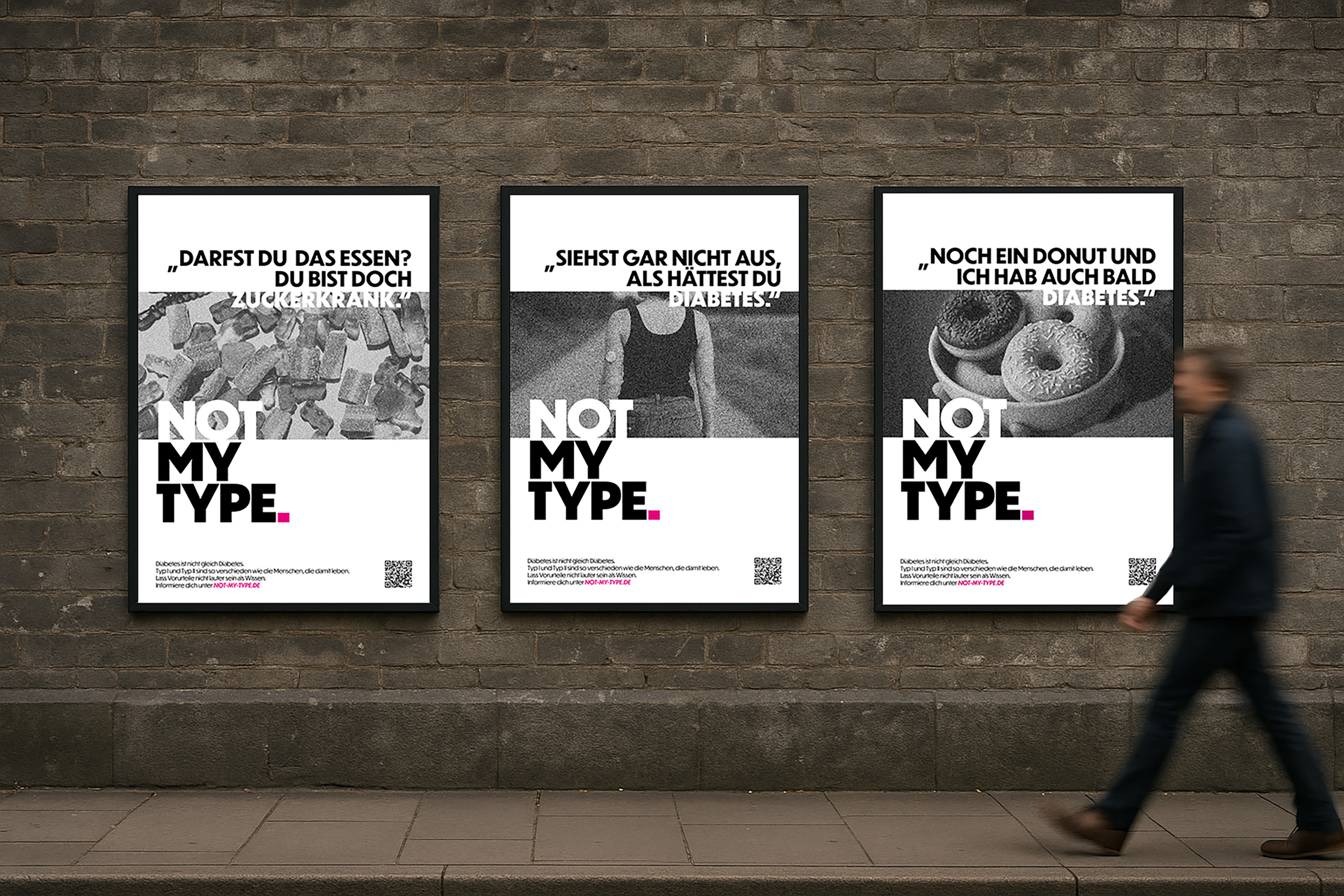
A multi-channel campaign that challenges stereotypes around Type-1 diabetes. Bold, direct, and built to spark awareness.
The Challenge
The social world is filled with stereotypes around diabetes, especially projected on patients with type one. This is due to the lack of education in the general public which leads to confusion between the different types of this disease. The ongoing confrontation with these false stereotypes is proven to have negative results on patients and their treatment as well as the relationship to their own health.
The challenge of this project: Attempt to disrupt the stereotypes and change the way people think and talk about (type-1) diabetes.
My Approach
It surely is not an easy task to change mindsets that have been living in peoples' heads for as long as forever. Therefore my approach was to, first understand the psychology behind stereotypes and how to break them with the help of behavioural science.
With these insights I attempted to develop and design a multi-channel campaign identity, that could possibly challenge how people look at diabetes and their patients.
Results & Outcome
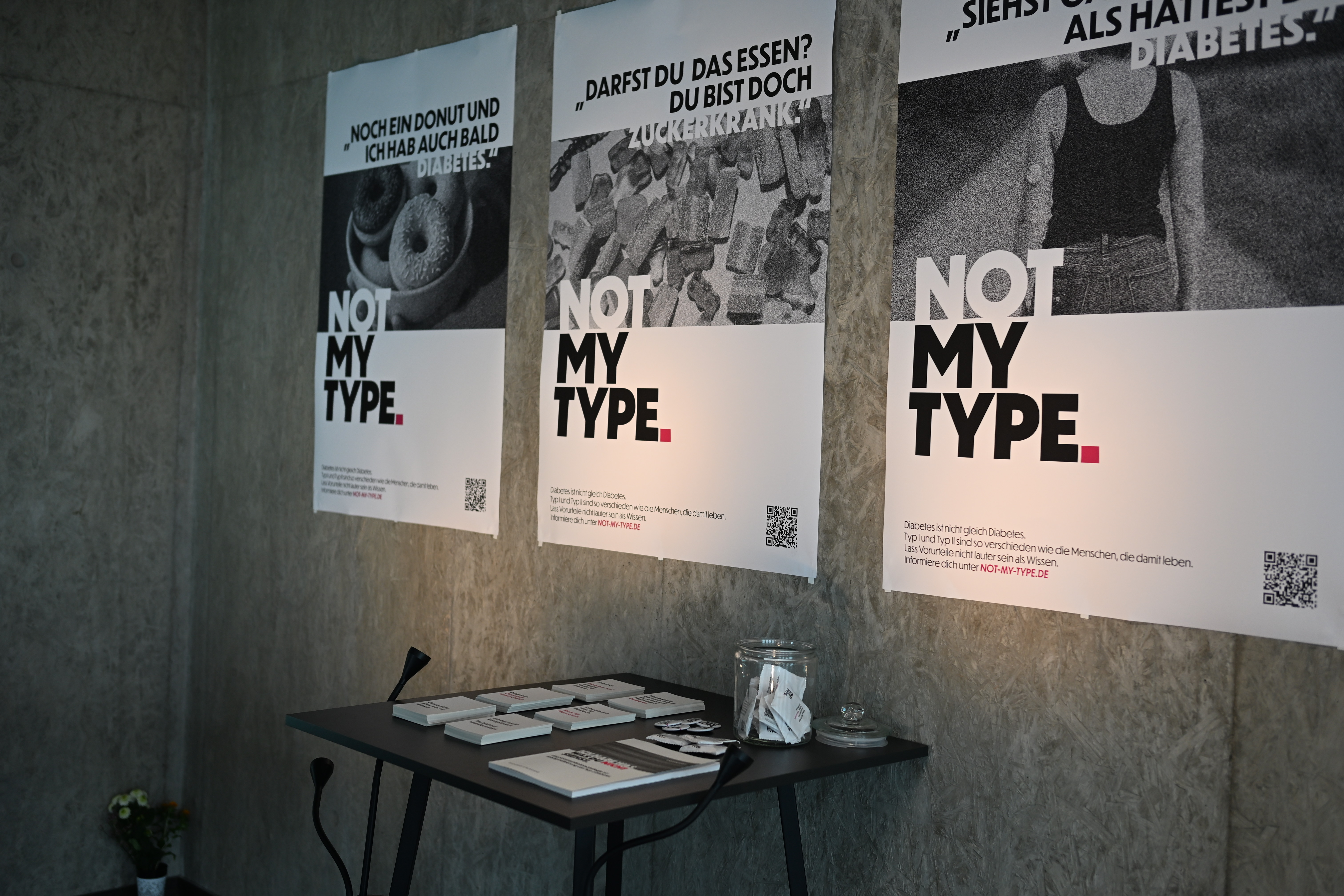
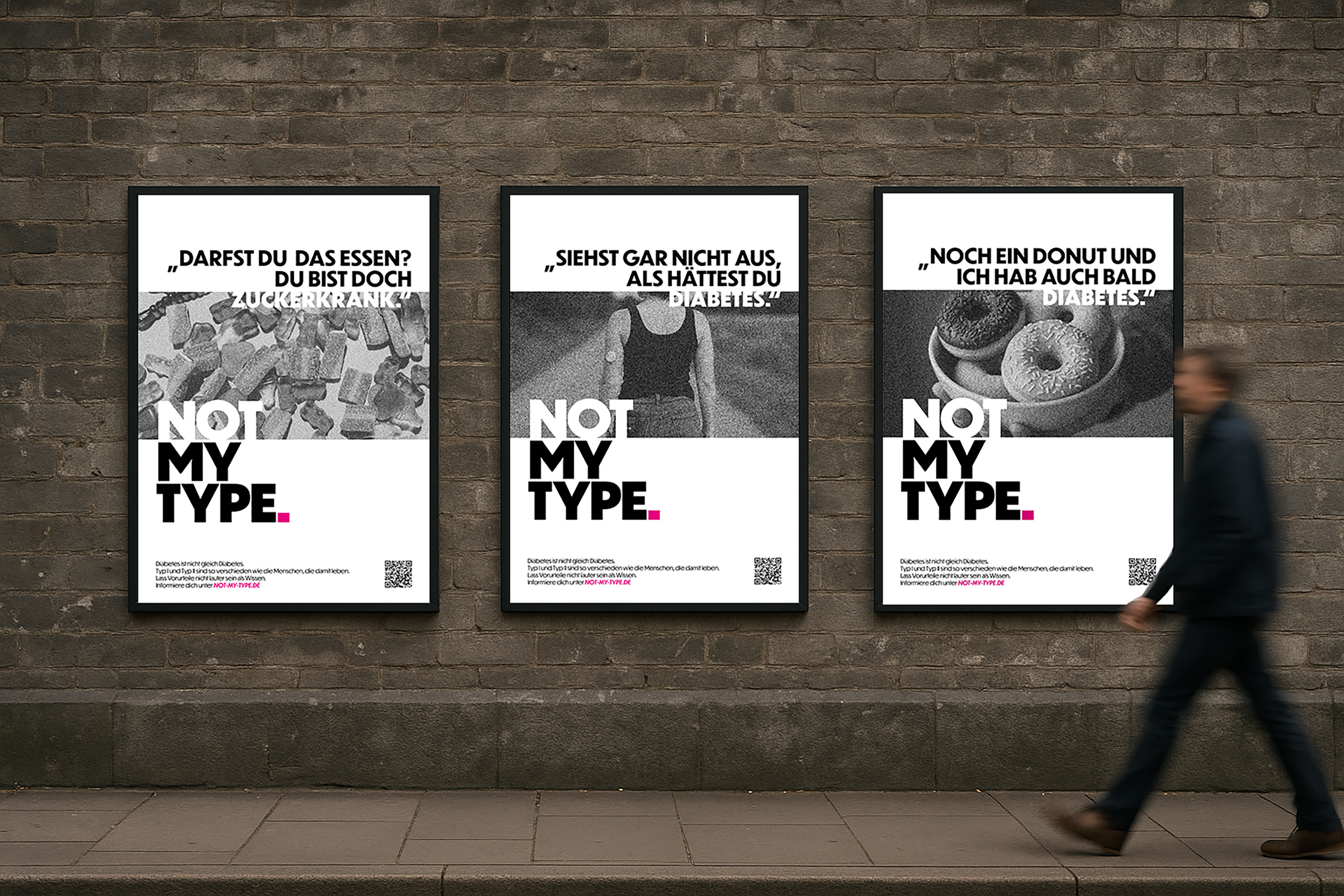
The result of this task is a multi-channel campaign, based off scientific research as well as creative strategies focusing on typographical use for stronger storytelling. It includes poster for OOH representation, social media concepts as well as merchandising to spread awareness on all possible directions.
Services Delivered
Not My Type. is a behavioural-psychology-grounded communication campaign built to dismantle a quiet, everyday form of harm: the casual confusion of Type 1 and Type 2 Diabetes — and the stereotypes that confusion drags with it. Developed as my Bachelor's thesis in Communication and Product Design at HTW Dresden, the project moves from peer-reviewed research and original empirical work through two full concept phases into a finished campaign package: a poster series for out-of-home placement, a coordinated social media strategy, short-form video, and a campaign website first built in Webflow, at the moment it is getting newly programmed.
This case study walks through how it was made — the research, the discarded first concept, the strategic pivot, and the final design system.
Type 1 Diabetes is an autoimmune disease. The immune system destroys the insulin-producing cells in the pancreas. It is not caused by diet, lifestyle, or weight. It cannot be cured, reversed, or trained away. People with Type 1 inject insulin every day for the rest of their lives.
None of that is what the public hears.
In public perception, "diabetes" is one thing — typically Type 2, typically framed as self-inflicted. The conflation isn't pedantic; it has measurable consequences. Peer-reviewed research by Brazeau et al. (2018) found that 65.5% of adolescents and young adults with Type 1 Diabetes report stigma-related experiences, and stigmatised patients carry more than double the risk of poor glycemic control and nearly double the risk of severe hypoglycemia. Stigma is not a feeling. It is a clinical risk factor.
The campaign brief, then: change how people talk about Type 1 — because how people talk shapes how patients treat themselves.
The research phase was deliberately heavy. A communication campaign about a deeply misunderstood medical condition cannot rest on intuition.
Competitive campaign analysis. I analysed three reference campaigns in the space: Medtronic's #BlueBalloonChallenge (developed by MadeBrave) — strong on metaphor and participation, weak on type differentiation; Helmholtz/GPPAD's K1DS ARE HEROES — strong visual presence, but top-down and superhero-coded in a way that creates distance; and Abbott's #DiabetesStigma / Let's Change Perspective — sharp on language sensitivity but conspicuously avoiding the Type 1 / Type 2 distinction, which, given the brief, reinforces exactly the stereotype it claims to address. The gap was clear: nothing in the existing landscape was differentiating type while also activating reflection.
Behavioural psychology. The campaign's theoretical spine is Daniel Kahneman's two-systems model from Thinking, Fast and Slow. Stereotypes are System 1 phenomena — fast, automatic, associative. They form through repetition and feel like truth because they feel familiar. System 2 — slow, deliberate, effortful — only activates when something contradicts the world-model System 1 maintains. So the design problem isn't "communicate facts." It's "engineer cognitive friction." A campaign that wants to break a stereotype has to first interrupt the automatic reading.
Original empirical research. I ran an online survey (70 respondents, structured into separate question paths for affected and non-affected participants) and conducted two semi-structured qualitative interviews — Angelina (16, school context) and Tom (24, university and sport context). The survey produced quantitative measures of stigma frequency among Type 1 patients (the statement "someone confuses Type 1 with Type 2" scored a 4.57/5 average) and mapped which communication formats non-affected respondents found most likely to shift their thinking (personal stories, visual metaphors, social media). The interviews added texture: how stigma actually shows up in classrooms, in changing rooms, on courts.
The combined research output became the input to design.
The first concept was built around the metaphor of the shadow — survey-validated as resonant, psychologically loadable (Plato's cave, Jung's shadow work), and visually rich. Posters explored the shadow as a constant companion: not enemy, not foreign body, but integrated self. Interactive installation formats with light and movement were sketched. The aesthetic moved away from typical advertising gloss toward something quieter and more atmospheric.
It looked good. It tested well emotionally.
And then I cut it.
The problem only surfaced under critical review: the shadow metaphor was too universal. It described the experience of any chronic illness. It had no specific anchor to Type 1, no friction with the Type 1 / Type 2 confusion that was the entire reason for the campaign. Returning to the Kahneman framework: the shadow created emotional resonance, but no System 2 trigger. It explained. It didn't interrupt. And without interruption, stereotypes stay where they are.
This is, in retrospect, the most important part of the project. The willingness to scrap a concept that was already eight weeks deep, that was beautiful, that worked on the surface — because it wasn't doing the actual strategic job — is the difference between a portfolio piece and a campaign that works.
The second concept started from a different observation. Stereotypes about Type 1 don't usually arrive as images. They arrive as sentences. "Are you even allowed to eat that?" "You probably had too much sugar as a kid." "So much sugar, I'm going to get diabetes." "But you don't look diabetic." These are the small, recurring acts of misrecognition that, repeated, become the public understanding of the disease.
So the campaign's material became language itself. Quoted sentences. Things actually said to people with Type 1. Pulled out of context, set in serious typography, paired with a single response.
The claim emerged from a wordplay that does several jobs at once:
"Type" is borrowed from dating vocabulary, where it is unmistakably present in the social-media language of the target audience. "Type" is also the medical category being confused. And "type" is, of course, typography — the literal material the posters are made of.
One phrase, three layers, one strategically loaded period: Not my type. Diabetes is not the same as diabetes.
This is the System 2 trigger the first concept lacked. A familiar phrase, lifted into an unfamiliar context, generates exactly the cognitive dissonance Kahneman's model requires to make a stereotype reviewable.
Visual reduction as strategic position. The category default in health awareness campaigns is loudness — saturated colour, urgent imagery, emotional appeals. Not My Type. moves in the opposite direction. The reduction isn't aesthetic preference; it's a strategic claim. When the content of the message is a misuse of language, the design has to let that language breathe. White space is where reflection happens.
Typography. Dunbar Tall is used across the entire system. Tall, narrow, present without being aggressive — it carries authority for the medical content while staying contemporary enough for a young audience. The single typeface across every touchpoint creates instant recognition.
Colour. Black and white throughout, with one strategic exception: a magenta full stop after NOT MY TYPE. The period — the punctuation of finality — becomes the loudest element on the poster. Urgent, but not catastrophic. Not red, not warning. A signal, not an alarm.
Photography. Black-and-white, digitally noised. The interference pattern reads at two levels: it functions visually as a hook (the eye stops on it because it looks wrong), and it acts as a metaphor for the cognitive interference the message is trying to create. The static is the System 1 / System 2 friction made literal.
The poster mechanic. Each poster pairs a quoted stereotype — "Darfst du das essen? Du bist doch zuckerkrank." / "Are you even allowed to eat that?" — with the campaign response NOT MY TYPE. A small information block clarifies the difference between Type 1 and Type 2; a QR code routes to the campaign website for deeper engagement.
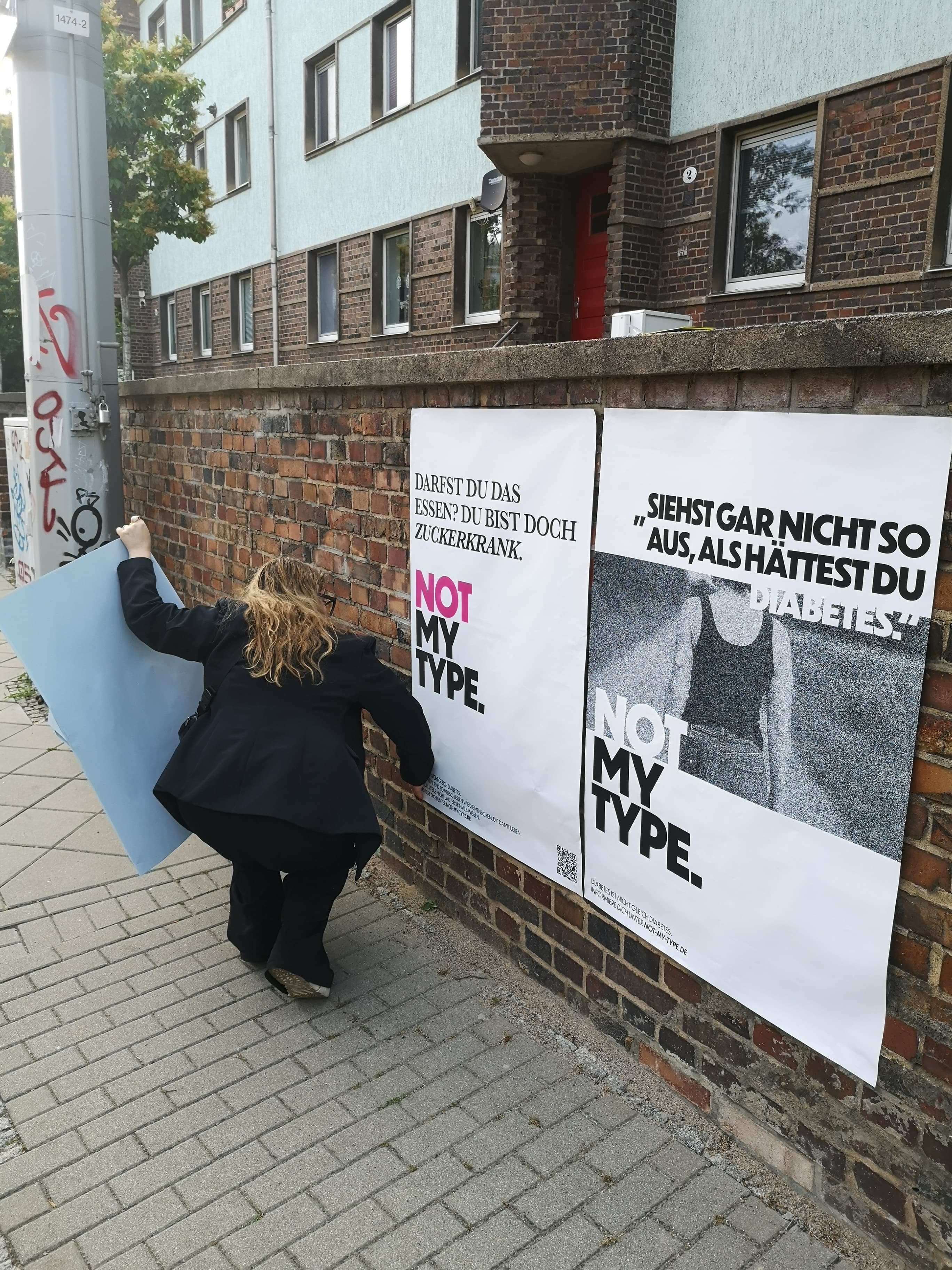
Real-world testing. I printed four final variants at A0 and guerrilla-tested them in public space — bus stops, utility boxes, walls — to evaluate legibility, hierarchy, and recognition at distance. The tests changed the final design: legibility needed more support, which led to the introduction of the magenta accent on the typographically-led variant. The colour decision was empirical, not stylistic.
The campaign was built as a connected system rather than a single artefact.
Out-of-home posters. The primary medium. Designed to operate as interventions in everyday space — placed where people don't expect education to find them. Multiple motifs were developed, allowing rotation across the campaign run.
Short-form video. Three social-media videos extend the poster logic into motion. Each shows a realistic everyday scene in which a stereotyped comment is made about Type 1 Diabetes. At the moment the comment lands, the image and audio glitch — the same "interference" aesthetic from the posters. NOT MY TYPE. resolves the disruption. Scenarios are drawn from real situations reported by interview participants and survey respondents. Storyboarded, voiced, and produced as part of the deliverable package.
Campaign website. Designed and built in Webflow as the central hub. The site holds the educational content (Type 1 vs Type 2, the research, the stigma data), surfaces the posters and videos, and invites participation — visitors can submit their own quoted stereotypes, share statements, and pass the campaign forward. Information architecture was developed via sitemap and wireframes in Figma before being built directly in Webflow for production efficiency.
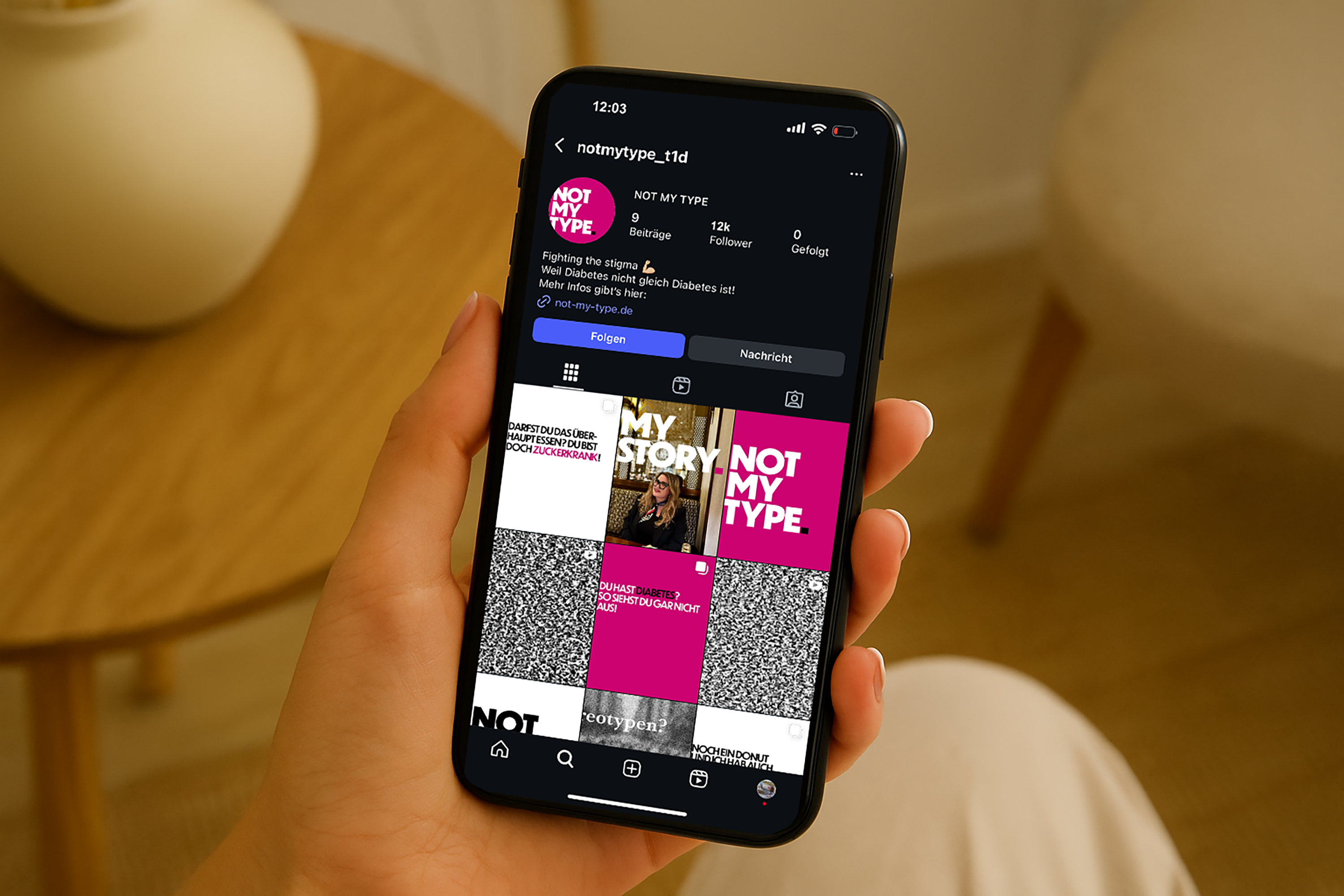
Social media strategy. A complete content design system for Instagram and TikTok: feed posts, carousels, story templates, and Reels, all working within the same typographic and tonal system. A fictional content plan was developed for the launch week, and a mock Instagram feed was assembled to validate the aesthetic in context. The format mix is deliberate — educational carousels for retention, Reels for reach, story formats for community participation, and explicit space for affected people to speak in their own voice.
Campaign briefing. The final deliverable is a complete campaign briefing document — the bridge between thesis and real-world implementation. In the event of an actual launch, it functions as the starting point for production planning.
For anyone reviewing this case study with a hiring or commissioning brief in mind, the project shows several things at once:
Strategy and execution from the same hand. The work moves from peer-reviewed source material and original empirical research through positioning, claim development, art direction, and full production across print, web, and motion — without handoff loss between phases.
Willingness to kill the wrong concept. Eight weeks into the shadow direction, I shipped a different concept. This kind of intellectual honesty is the actual production cost of strategic work and the thing that separates concepts that win awards from concepts that change minds.
Real research, used. The Kahneman framework isn't a citation; it's the engineering principle behind the campaign's central mechanic. The Brazeau et al. data isn't a statistic on a slide; it's the reason the brief exists. Survey and interview findings show up materially in the choice of metaphors, the language register, the channel mix.
Production breadth. InDesign for editorial; Illustrator for typographic layout; Photoshop for the interference photography; Figma for IA and wireframes; Webflow for the live campaign site; Premiere for the videos; print testing for the posters. End-to-end.
Editorial and verbal craft. The campaign hinges on a single triple-layered phrase. Finding the right words is the whole project. The thesis itself — 140 pages, fully designed in InDesign — is part of the deliverable.
I have lived with Type 1 Diabetes for roughly twenty years. I have heard every sentence on every poster in real life, often more than once. This is part of why the project exists. It is also why I treated the research phase with the seriousness I did — because lived experience is a starting point for relevance, not a substitute for evidence. The campaign earns its claim not because I have the disease, but because the methodology stands up.
If destigmatisation is a marathon, Not My Type. is one well-engineered kilometre of it.
Bachelor's thesis, Communication and Product Design, HTW Dresden, 2025. Supervisors: Prof. Dr. Florian Alexander Schmidt, Prof. Diana Simon. Available as a complete documentation on request.
Bachelor's thesis, Communication and Product Design, HTW Dresden, 2025. Available as a complete documentation on request.